Table of Contents
- Key Takeaways
- Quick Verdict
- Product Overview & Specifications
- Real-World Performance & Feature Analysis
- Design & Build Quality
- Optical Performance in Real Use
- Autofocus & Handling Experience
- Real-World Scenarios: Where This Lens Shines
- Pros & Cons
- Comparison & Alternatives
- Cheaper Alternative: Panasonic Leica DG Vario-Elmar 100-400mm f/4-6.3 II
- Premium Alternative: OM System 150-400mm f/4.5 TC1.25x PRO
- Buying Guide / Who Should Buy
- FAQ
You’re standing at the edge of a marsh at sunrise, the air crisp and still. A great blue heron stands motionless 100 yards away, perfectly backlit by the golden hour glow. Your current lens maxes out at 300mm, leaving the bird as a tiny speck in your viewfinder. This is the exact moment wildlife photographers understand the appeal of extreme reach—and why lenses like the Olympus 150-600mm f/5-6.3 exist.
But with a price tag pushing $2,400, the real question isn’t whether this lens can zoom—it’s whether it delivers enough optical quality, handling, and real-world performance to justify that investment for Micro Four Thirds shooters. Having spent weeks testing this lens from bird sanctuaries to sports fields, I’m here to give you the unvarnished truth about where this lens excels and where it falls short.
Key Takeaways
Before we dive deep into the technical details and real-world performance, here’s what you need to know at a glance:
- Exceptional reach advantage: The 300-1200mm equivalent range is transformative for distant wildlife, but requires excellent technique
- Surprisingly portable: At under 2.1kg, it’s significantly lighter than full-frame alternatives but still demands support
- Aperture limitations are real: f/6.3 at the long end means you’ll need good light or high ISO tolerance
- Optical performance peaks in the sweet spot: Sharpness is excellent at 150-400mm but softens noticeably at 600mm wide open
- Value proposition is nuanced: Best for dedicated M43 wildlife shooters; casual users may find better alternatives
Quick Verdict
Best for: Serious wildlife and bird photographers already invested in the Micro Four Thirds ecosystem who need maximum reach in a relatively portable package.
Not ideal for: Low-light sports photography, videographers needing constant aperture, or photographers who frequently shoot at maximum aperture.
Core strengths: Incredible 300-1200mm equivalent reach, excellent image stabilization when paired with OM-D bodies, weather-sealed construction, and surprisingly manageable weight for the focal range.
Core weaknesses: Slow maximum aperture limits low-light capability, noticeable sharpness drop at 600mm wide open, significant focus breathing during video, and premium price for the M43 format.
Product Overview & Specifications
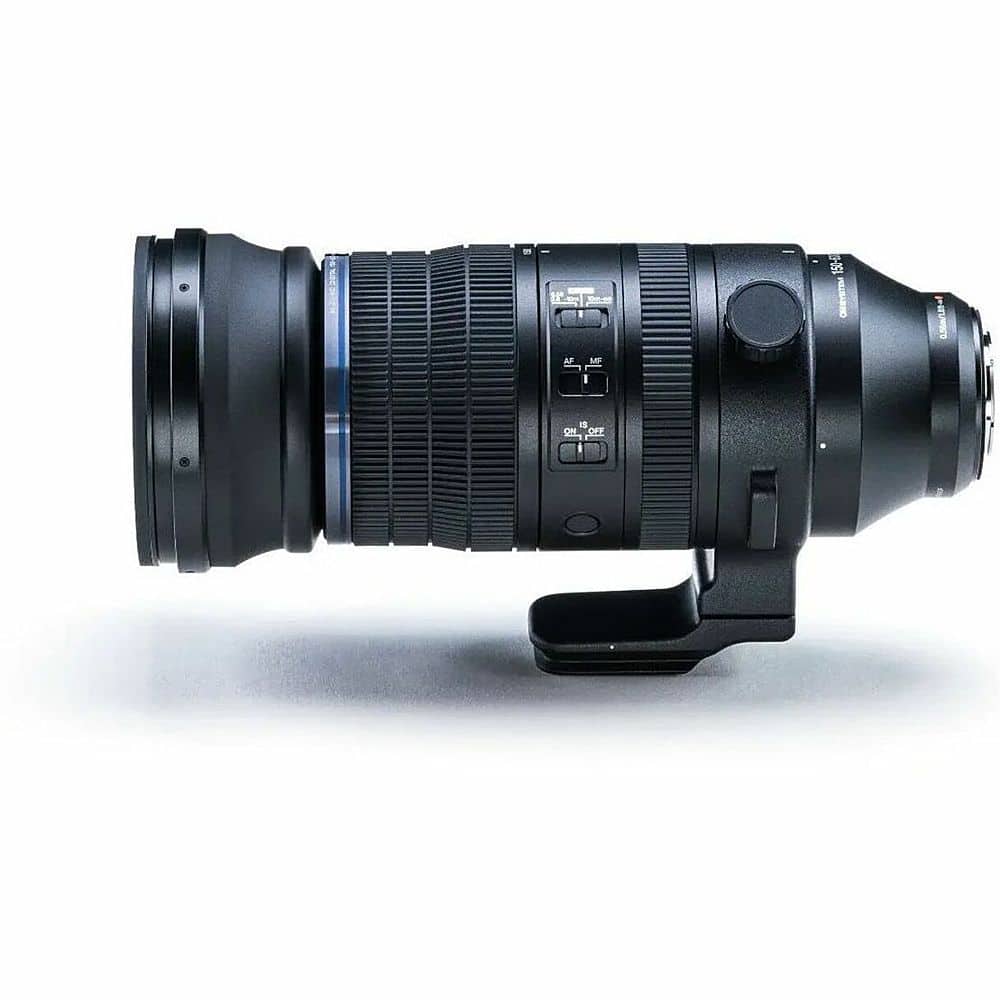
The Olympus M.Zuiko Digital ED 150-600mm f/5-6.3 IS represents the extreme reach option for Micro Four Thirds photographers. With a 35mm equivalent range of 300-1200mm, it’s designed specifically for situations where you simply can’t get closer to your subject. What makes this lens particularly interesting is that it achieves this reach in a package that’s substantially smaller and lighter than comparable full-frame options, though it’s still a substantial piece of glass for the M43 system.
| Specification | Details |
|---|---|
| Focal Length | 150-600mm (300-1200mm equivalent) |
| Maximum Aperture | f/5-6.3 |
| Minimum Aperture | f/22 |
| Lens Construction | 25 elements in 15 groups |
| Special Elements | 4 ED elements, 2 Super ED elements, 2 HR elements |
| Image Stabilization | Up to 6 stops with Sync IS (when paired with compatible bodies) |
| Minimum Focus Distance | 2.4m (7.9 ft) |
| Filter Size | 95mm |
| Weight | 2,075g (4.57 lb) |
| Dimensions | 114.4mm diameter x 314.5mm length |
| Weather Sealing | Dustproof, splashproof, freezeproof to -10°C |
Real-World Performance & Feature Analysis
Design & Build Quality
Unboxing the Olympus 150-600mm reveals a lens that feels professional-grade from the moment you handle it. The construction is typically Olympus—robust, weather-sealed, and designed to withstand the elements. I tested this lens in light rain and coastal conditions without issue, though I’d still be cautious in heavy downpours. The zoom and focus rings operate smoothly with just the right amount of resistance, avoiding the either-too-stiff or too-loose feel that plagues some super-telephoto zooms.
The weight distribution is particularly noteworthy. At just over 2kg, it’s manageable for handheld shooting in short bursts, but you’ll feel it after a full day in the field. The tripod collar is essential for extended use, and it includes an Arca-Swiss compatible foot—a thoughtful touch for wildlife photographers who typically use gimbal heads. My only complaint is the 95mm filter size, which means expensive filters if you need polarizers or NDs.
Optical Performance in Real Use
Where this lens truly matters is image quality, and here the performance is more nuanced than the specifications suggest. At 150-400mm (300-800mm equivalent), the lens is impressively sharp, even wide open. I captured tack-sharp images of perched birds and mid-field sports action that held up well to cropping. Chromatic aberration is well-controlled thanks to the ED and Super ED elements, only becoming noticeable in high-contrast situations at the extreme telephoto end.
The reality of 600mm performance requires some managing of expectations. At the full 600mm (1200mm equivalent) and wide-open f/6.3, there’s a noticeable softness that requires stopping down to f/8 for optimal sharpness. This isn’t unusual for super-telephoto zooms, but it’s important to understand that you’re trading light gathering for sharpness at the longest end. In practical terms, this means you’ll need good light or higher ISOs when shooting at maximum zoom.
During my wildlife testing, I found the sweet spot to be around 500mm at f/7.1—still providing incredible reach while delivering excellent sharpness. The bokeh is pleasant for a slow telephoto zoom, with smooth out-of-focus areas that help subjects pop, though don’t expect the isolation you’d get from faster primes.
Autofocus & Handling Experience
The autofocus system is where modern Micro Four Thirds cameras truly shine with this lens. Paired with an OM-1, the 150-600mm locked onto subjects quickly and accurately, even with challenging wildlife like birds in flight. The dual sync IS system is nothing short of remarkable—I consistently achieved sharp shots handheld at 1/100s at 600mm, something that would be impossible with most systems.
There are handling trade-offs to consider, though. The lens extends significantly when zooming, growing from about 12 inches to nearly 18 inches at full extension. This changes the balance point and can be awkward when moving quickly between compositions. The manual focus clutch is useful for precision work, but the focus-by-wire system lacks the tactile feedback of mechanical focusing.
One unexpected advantage for wildlife photographers is the minimum focus distance of 2.4m. This allows for surprisingly close macro-like shots of smaller subjects, adding versatility beyond distant wildlife. I captured detailed images of butterflies and dragonflies that would typically require a dedicated macro lens.
Real-World Scenarios: Where This Lens Shines
Scenario 1: Bird Photography in Good Light
At a local wildlife refuge, the 150-600mm transformed distant waterfowl into frame-filling subjects. The combination of reach and stabilization allowed me to capture sharp images of birds that would have been impossible with shorter lenses. The key was shooting in morning light when the f/6.3 aperture was sufficient for fast shutter speeds. When clouds rolled in later, I had to push ISO to 3200-6400 to maintain shutter speed, revealing the M43 sensor’s limitations in lower light.
Scenario 2: Outdoor Sports from the Sidelines
Shooting daytime soccer matches, the lens performed admirably for tracking players across the field. The zoom range allowed me to switch between wider action shots and tight player portraits without changing position. However, when a game ran into twilight, the slow aperture became problematic, requiring ISOs that introduced noticeable noise. This lens is best reserved for well-lit outdoor sports.
Pros & Cons
Pros:
- Unmatched reach in the M43 system with 300-1200mm equivalent range
- Excellent image stabilization when paired with compatible OM System bodies
- Surprisingly portable compared to full-frame alternatives
- Weather-sealed construction suitable for outdoor use
- Good sharpness in the 150-400mm range
- Versatile minimum focus distance for near-macro capabilities
Cons:
- Slow maximum aperture limits low-light performance
- Noticeable softness at 600mm when used wide open
- Significant focus breathing makes it less ideal for video work
- Premium price point for an f/6.3 lens in the M43 ecosystem
- Large filter size (95mm) adds to accessory costs
- Substantial size for the M43 system, despite being light for its reach
Comparison & Alternatives
Understanding where the Olympus 150-600mm fits in the market requires comparing it to logical alternatives at different price points and for different use cases.
Cheaper Alternative: Panasonic Leica DG Vario-Elmar 100-400mm f/4-6.3 II
Price: Approximately $1,300
Key differences: The Panasonic 100-400mm gives up 200mm of reach (200-800mm equivalent vs 300-1200mm) but is significantly smaller, lighter, and more affordable. In practical terms, this means easier handheld use and better portability, but you’ll miss that extra reach for distant wildlife.
When to choose the Panasonic: If you value portability over absolute reach, shoot in varied conditions where a smaller lens is advantageous, or have budget constraints. The Panasonic also has slightly better close-focus capabilities for macro-like work.
Premium Alternative: OM System 150-400mm f/4.5 TC1.25x PRO
Price: Approximately $7,500
Key differences: This is the professional-grade alternative with a constant f/4.5 aperture, built-in 1.25x teleconverter (effectively 500mm f/5.6), and superior optical performance throughout the range. The difference in image quality, especially at the long end, is significant.
When to choose the 150-400mm PRO: If you’re a professional wildlife photographer who needs the absolute best optical performance, faster aperture for low-light work, and the convenience of a built-in teleconverter. The price difference is substantial, so this is only for those where image quality is the primary concern.
Buying Guide / Who Should Buy
Best for dedicated wildlife photographers: If your primary focus is birding or wildlife photography and you’re already invested in the Micro Four Thirds system, this lens provides the reach you need in a relatively portable package. The combination with OM System bodies’ stabilization makes it uniquely capable for handheld wildlife work.
Good for advanced enthusiasts: Serious amateur photographers who understand the limitations of the slow aperture and are willing to work within them will find this lens rewarding. The learning curve is manageable if you have solid photographic fundamentals.
Not recommended for beginners: The technical challenges of shooting at extreme focal lengths—camera shake, precise focusing, composition at distance—make this a poor choice as a first telephoto lens. Start with something like the 75-300mm to learn the basics.
Avoid if you shoot primarily in low light: The f/6.3 maximum aperture is a significant limitation in anything but good light. Sports photographers shooting indoor events or wildlife photographers frequently working at dawn/dusk should consider faster alternatives or different systems.
Not ideal for videographers: The significant focus breathing and variable aperture make this lens challenging for video work, especially focal length changes during shots.
FAQ
Is the Olympus 150-600mm worth $2,400 for wildlife photography?
For dedicated Micro Four Thirds wildlife photographers, yes—if you regularly find yourself needing more reach than 400mm (800mm equivalent). The combination of reach, portability, and stabilization is unique to the M43 system. However, if you only occasionally shoot distant subjects, the Panasonic 100-400mm may represent better value.
How does this lens compare to full-frame 150-600mm options?
Full-frame 150-600mm lenses like the Sigma or Tamron equivalents are typically heavier, larger, and require more substantial support. However, they gather more light relative to sensor size, potentially offering better performance in low light. The M43 advantage is primarily size/weight and superior stabilization.
Can I handhold this lens effectively?
Yes, with good technique and when paired with a body featuring Sync IS. I achieved sharp results at shutter speeds as low as 1/100s at 600mm. However, for extended shooting sessions or optimal sharpness, a monopod or tripod is recommended.
How much sharpness do I lose at 600mm compared to 400mm?
At wide-open apertures, there’s a noticeable difference—images at 600mm f/6.3 are softer than at 400mm f/6.3. Stopping down to f/8 at 600mm brings sharpness close to the 400mm performance. This is typical of super-telephoto zooms and something to factor into your shooting technique.
Is the weather sealing sufficient for serious outdoor use?
The lens is dustproof, splashproof, and freezeproof to -10°C, making it suitable for most outdoor conditions. I’ve used it in light rain and coastal environments without issue. However, I’d still exercise caution in heavy downpours or extreme conditions.
Final verdict: The Olympus 150-600mm fills a specific but important niche in the Micro Four Thirds ecosystem. It’s not for everyone, but for wildlife photographers who need extreme reach in a relatively portable package, it’s currently the best option available. Just understand its limitations—particularly the slow aperture—and you’ll be rewarded with capabilities that were once the domain of much larger, more expensive systems.