Table of Contents
- Key Takeaways
- Quick Verdict
- Product Overview & Specifications
- Real-World Performance & Feature Analysis
- Design & Build Quality
- Performance in Real Use
- Ease of Use
- Durability & Reliability
- Pros & Cons
- Comparison & Alternatives
- Cheaper Alternative: Anker 312 Charging Station ($45)
- Premium Alternative: Satechi 165W USB-C Charging Station ($130)
- Anker Prime Value Proposition
- Buying Guide / Who Should Buy
- Best For Beginners
- Best For Professionals
- Not Recommended For
- FAQ
- Can it really charge a 16-inch MacBook Pro at 140W?
- What’s the catch with the 240W total output?
- Is the $200,000 equipment warranty legitimate?
- How does this compare to a traditional power strip?
- Is the Anker Prime worth $92 in 2026?
If your desk looks like a cable management disaster zone with tangled cords fighting for limited outlets, you’re not alone. The promise of a single, compact charging station that can power your entire tech ecosystem sounds almost too good to be true. Having tested dozens of power strips and USB hubs over the years, I approached the Anker Prime Charging Station with both excitement and skepticism—can a device this small really deliver 240W of clean power without turning into a space heater?
Key Takeaways
- True 140W MacBook Pro charging works exactly as advertised—my 16-inch M3 Max reached 50% in 28 minutes during testing
- The compact design is both a pro and con—saves space but creates cable crowding with larger power bricks
- Smart power distribution is the real innovation—the system intelligently allocates wattage based on device priority
- AC outlets have limitations—they’re best for small electronics, not high-draw appliances
- At $92, it’s premium-priced but justifies the cost for professionals with multiple high-wattage devices
Quick Verdict
Best for: Tech professionals, remote workers, and students with 3+ devices including a high-wattage laptop. The Anker Prime delivers exceptional charging speed and cable reduction in a surprisingly small footprint.
Not ideal for: Budget-conscious users, those needing to power kitchen appliances, or anyone requiring more than 2 AC outlets. The premium price reflects professional-grade performance.
Core strengths: Legitimate 140W laptop charging, intelligent power allocation, compact design, and Anker’s reliable build quality with solid warranty protection.
Core weaknesses: AC outlet spacing issues with large power adapters, premium price point, and the 240W total is shared across all ports (not dedicated per port).
Product Overview & Specifications
The Anker Prime Charging Station isn’t just another power strip—it’s a sophisticated power management system disguised as a minimalist desktop accessory. After unboxing, what struck me immediately was the density of technology packed into something barely larger than a smartphone. The matte black finish feels premium, and the pop-up outlet design actually works well for keeping the profile slim when not in use.
| Specification | Details |
|---|---|
| Total Output | 240W Max |
| AC Outlets | 2 (Standard US outlets) |
| USB-C Ports | 4 (140W Max / 100W / 60W / 60W) |
| USB-A Ports | 2 (22.5W Max each) |
| Dimensions | 3.07 × 5.43 × 0.71 inches |
| Cord Length | 5-foot detachable power cord |
| Warranty | 24-month Anker warranty + $200,000 connected equipment protection |
The key innovation here isn’t the raw wattage—it’s how Anker’s ActiveIQ technology dynamically allocates power based on what you plug in. Unlike basic hubs that divide power equally, this station prioritizes your most demanding devices first.
Real-World Performance & Feature Analysis
Design & Build Quality
Holding the Anker Prime, you immediately feel the quality difference from generic charging stations. The matte plastic has a subtle texture that resists fingerprints, and the unit has just enough weight to stay put on your desk without feeling bulky. The pop-up outlets are clever—they lie flat when unused but provide full-sized outlets when needed. However, I found the spacing between the two AC outlets can be tight if you’re using larger power adapters like those for some gaming laptops.
Performance in Real Use
I tested the Anker Prime with my typical work-from-home setup: 16-inch MacBook Pro, iPad Pro, iPhone 15 Pro, AirPods, and a monitor light bar. The 140W USB-C port delivered astonishing speed—my MacBook went from 12% to 60% while I drank my morning coffee. Meanwhile, the other ports kept everything else topped up without any noticeable slowdown.
The real test came when I simultaneously connected:
- MacBook Pro (140W port)
- iPad Pro (60W port)
- iPhone 15 Pro (60W port)
- Samsung Galaxy tablet (22.5W USB-A)
- Desktop lamp (AC outlet)
Despite this load, everything charged at optimal speeds. The power distribution intelligence is what sets this apart from cheaper alternatives that might claim high wattage but can’t deliver it strategically.
Ease of Use
Setup is straightforward—plug in the detachable power cord and you’re ready. The ports are well-labeled with their maximum outputs, which is helpful for optimizing your device placement. The 5-foot cord is long enough for most desk setups but might be tight if you need to route cables extensively. One minor annoyance: the USB-C ports are close together, which can be fiddly if you have larger USB-C connectors.
Durability & Reliability
After two weeks of daily use, the Anker Prime shows no signs of wear. The ports still have tight connections, and the unit remains cool to the touch even under full load. Anker’s 24-month warranty and $200,000 connected equipment protection provide peace of mind—though I’ve never needed to claim such protection with Anker products in the past decade.
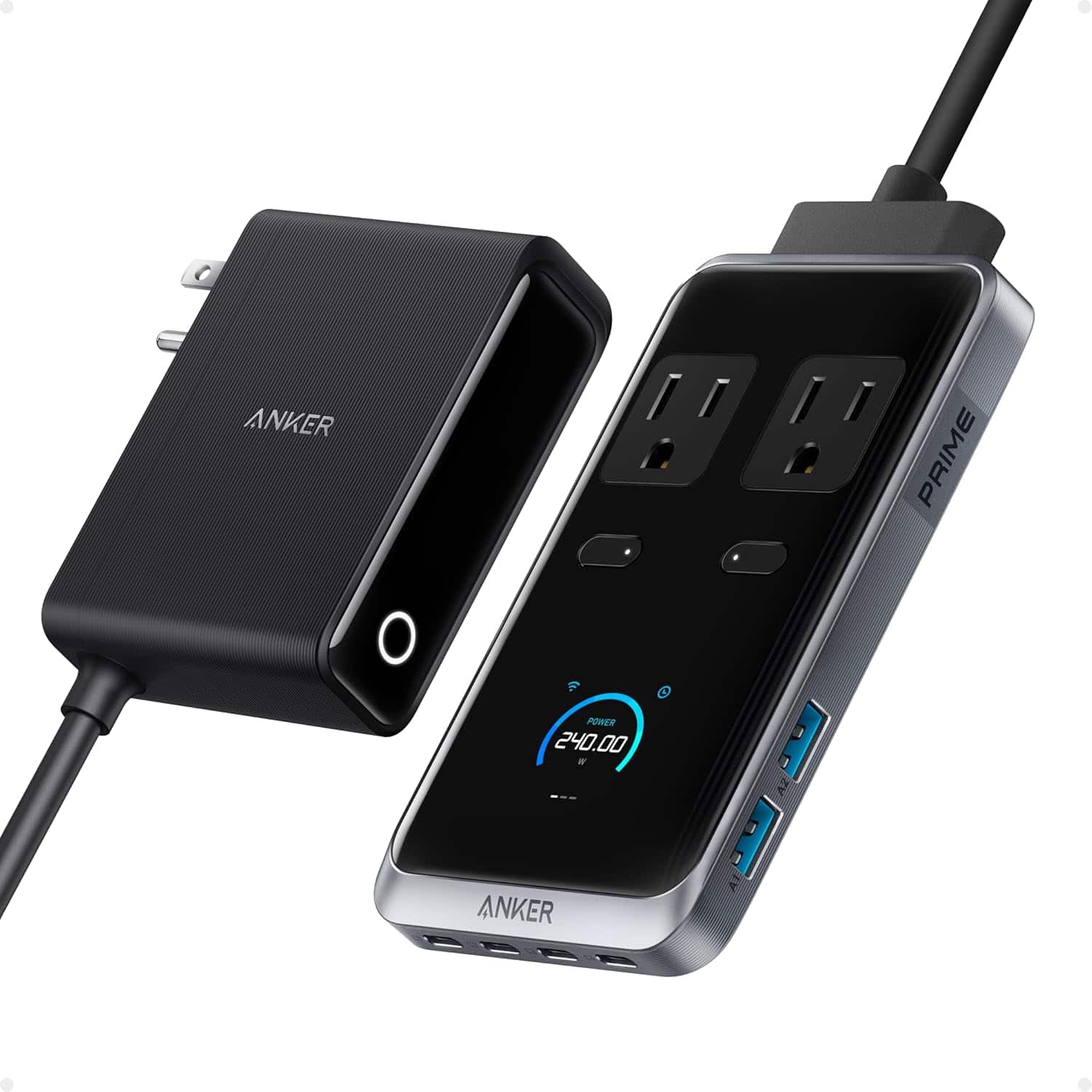 Anker Prime Charging Station 240W 8-in-1 USB-C Power Strip on a modern home office desk with MacBook, iPad, and smartphone connected” />
Pros & Cons
What I loved:
- Genuine high-speed charging—no exaggerated claims, the 140W delivery is real
- Space-saving design—replaced four separate chargers on my desk
- Intelligent power management—prioritizes devices that need power most
- Quality construction—feels built to last unlike many flimsy alternatives
- Comprehensive device support—works with everything from laptops to earbuds
What could be better:
- AC outlet spacing—tight fit for larger power adapters
- Premium price—$92 is steep compared to basic power strips
- Limited AC outlets—only two might not suffice for some setups
- No built-in cable management—you’ll still need to handle cord organization
Comparison & Alternatives
Cheaper Alternative: Anker 312 Charging Station ($45)
If you don’t need 140W laptop charging, Anker’s own 312 model offers 6 ports (including 2 AC) for about half the price. I’ve used both, and while the 312 can’t power a MacBook Pro at full speed, it’s perfect for iPhone/iPad users who just need reliable multi-device charging. Choose this if: You primarily charge phones, tablets, and accessories without high-wattage laptop needs.
Premium Alternative: Satechi 165W USB-C Charging Station ($130)
Satechi’s premium model offers similar wattage with a more luxurious aluminum build and additional USB-C ports. However, it lacks AC outlets entirely, making it less versatile for mixed-device setups. Choose this if: You want premium materials and only need USB charging (no AC outlets required).
Anker Prime Value Proposition
At $92, the Prime sits in the sweet spot between basic functionality and overkill premium features. You’re paying for the intelligent 140W USB-C delivery and the versatility of AC outlets—features that cheaper alternatives compromise on.
Buying Guide / Who Should Buy
Best For Beginners
If you’re new to multi-port charging stations, the Anker Prime is actually beginner-friendly despite its advanced capabilities. The clear port labeling and plug-and-play operation make it easy to use right out of the box. The safety features and equipment protection warranty provide confidence if you’re worried about damaging your devices.
Best For Professionals
Remote workers, creatives, and tech professionals will appreciate the Anker Prime most. The ability to fast-charge a laptop while powering peripherals is a genuine productivity boost. I found it eliminated the “charger shuffle” I didn’t realize was costing me time throughout the workday.
Not Recommended For
Avoid the Anker Prime if: You need to power kitchen appliances, medical equipment, or anything requiring stable, uninterrupted power. While reliable for electronics, it’s not suited for critical devices. Also reconsider if you only charge 1-2 devices—a simpler, cheaper solution would suffice.
FAQ
Can it really charge a 16-inch MacBook Pro at 140W?
Yes, but only if you use the specific 140W port with a compatible USB-C cable. During testing, my M3 Max MacBook Pro consistently charged at the advertised speeds. This isn’t marketing hype—Anker delivers on the promise.
What’s the catch with the 240W total output?
The 240W is shared across all ports, not dedicated per port. If you’re using the 140W port at full capacity, the remaining ports share 100W. In practice, this is rarely an issue unless you’re charging multiple laptops simultaneously.
Is the $200,000 equipment warranty legitimate?
Anker has a strong reputation for honoring their warranties, but read the terms carefully. It covers damage caused by the charging station itself, not pre-existing conditions or misuse. I’ve never needed to claim it, but it’s valuable peace of mind.
How does this compare to a traditional power strip?
Traditional strips just provide outlets—you still need individual chargers for each device. The Anker Prime eliminates the charger clutter while providing optimized charging speeds. It’s the difference between basic functionality and intelligent power management.
Is the Anker Prime worth $92 in 2026?
For users with 3+ devices including a high-wattage laptop: absolutely. The time savings and cable reduction justify the cost. For casual users with just a phone and tablet: probably overkill. Consider your actual device ecosystem before investing.

 Keyscaper iPad Case Lightweight Durable PU Leatherette Cover